
Is Canada Losing Its Education Edge? Strengthening Math & STEM Foundations in Grades 4-8
Recent international assessments are raising an alarming question: Is Canada losing its educational edge? Research shows that Canadian students are scoring lower than before on global tests, especially in mathematics. Once a consistent top performer, Canada has seen its rankings slip in recent years. For parents of children in Grade 4 to Grade 8, these trends hit close to home – these are the formative years for building strong foundations in math and science. In this post, we’ll explore what the latest data says, why early STEM skills matter, and how targeted support like tutoring can help reverse the decline.
Canada’s Math and Science Rankings: A Wake-Up Call
The latest numbers reveal that Canadian students’ math performance is middling on the world stage. In an international math test conducted by the IEA last year (a major assessment of Grade 4 and Grade 8 students), Canada ranked 32nd out of 64 countries. This is a startling result for a country that traditionally prides itself on a strong education system. Meanwhile, results from the 2022 Programme for International Student Assessment (PISA) – which measures 15-year-olds in math, reading, and science – show Canada still among the top 10 countries, but with steadily declining scores since the early 2000s. In fact, average math and reading scores in 2022 were lower than in any previous PISA cycle, reinforcing a negative trend that began years ago.
Why does this matter? It means that while Canadian students continue to score above the OECD average in core subjects, our overall performance is slipping in comparison to our past results and to top-performing countries. Nations in East Asia – like Singapore, South Korea, China, and Japan – now dominate the top spots in math and science. Canadian 15-year-olds are falling behind their peers from these education powerhouses, especially in mathematics, which experts identify as the subject of Canada’s biggest decline.
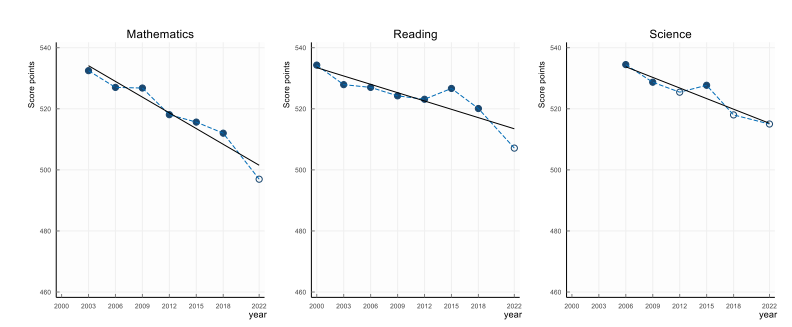
Figure: Distribution of top-performing and low-performing students in PISA 2022 for Canada vs. the OECD average (mathematics, reading, and science). Canada still boasts a higher share of top performers and a lower share of low performers than the OECD average, but its performance has declined over time. Notably, about 78% of Canadian students reach at least baseline proficiency in math (Level 2 or above), higher than the 69% OECD average – yet this also means roughly one in five Canadian students fell below the baseline in math.
These statistics are a wake-up call. For parents, they highlight that strong math and science skills need to be cultivated early. By Grade 4, foundational numeracy skills should be secure, and by Grade 8 students are preparing for the jump to high school STEM courses. If Canada’s standings are dropping at these levels, it’s a signal that we need to double down on supporting our kids during the elementary and middle school years.